Wednesday, April 6, 2011

Cow Candy

31 March 2011

There is a sugar cane industry in the area north of Brisbane.   Unfortunately, the regional sugar mill that was here for 106 years closed down a few years ago due to low sugar prices.  Most of the sugar cane fields just north of Brisbane are in a floodplain habitat and often become inundated, which makes the areas unsuitable for other crops.  A new business was created to use sugar cane as a cattle feed, similar to field-dried hay.  The company is called Cow Candy.  They take the entire cane crop, grind it up, dry it, and then bale it for export as a cattle feed.  They get approximately $300 per ton.  The cattle are not fed the Cow Candy exclusively, but rather have it mixed in with traditional dry feed.  It is believed that the sweetness of the Cow Candy will cause the cattle to consume more feed, therefore producing more milk.   The local community strongly supports this company, partly because of the aesthetic view the sugarcane provides to those living in the surrounding hill country.  Also, there is a long history of sugarcane farming in the region including some families that have been farming for at least four generations.  The Cow Candy company also produces a mulch for use in flower beds, similar to the company Organic Producers that was located in Thibodaux.  It amazes me how similar this region is to south Louisiana.

-Quenton


Tuesday, April 5, 2011

Rain put to use

29 March 2011

The host family Chris and I stayed with in Kingaroy, Richard and Robyn Rose, have a typical home for the area that uses a large amount of rainwater for everyday use.  Many of the homes in Australia use large collection tanks to collect rainwater from their roof gutter system.  Richard and Robyn use their rainwater for most of their daily needs (even for drinking) and only very rarely use city water.  This is a similar system to many of the hunting and fishing camps of Louisiana.  As much as it rains in Louisiana, this would be a great system to incorporate!  Every one of our host families have been extremely hospitable and I have immediately felt at home the minute I walked through the door.  I am learning as much about Australian ecology and culture through conversations with my host families as I am on scheduled tours and presentations.  This is a fantastic place and I cannot wait to return!

-Quenton

Kingaroy

29 March 2011

The VTT attended a natural disaster forum with members of the local council, fire and rescue, SES, and Centrelink.   Quenton and Robert gave a short presentation about Louisiana's challenges and recovery from recent natural disasters while local officials discussed their recent flooding events in Queensland.  The flood events caused more than $5 billion in damage with more than 80% of Queensland declared a disaster area.  We then visited Bunya Mountains National Park approximately 56 km (35 miles) northeast of Kingaroy.  The park is absolutely beautiful and everyone had the opportunity to take many amazing photos. 


Sunday, April 3, 2011

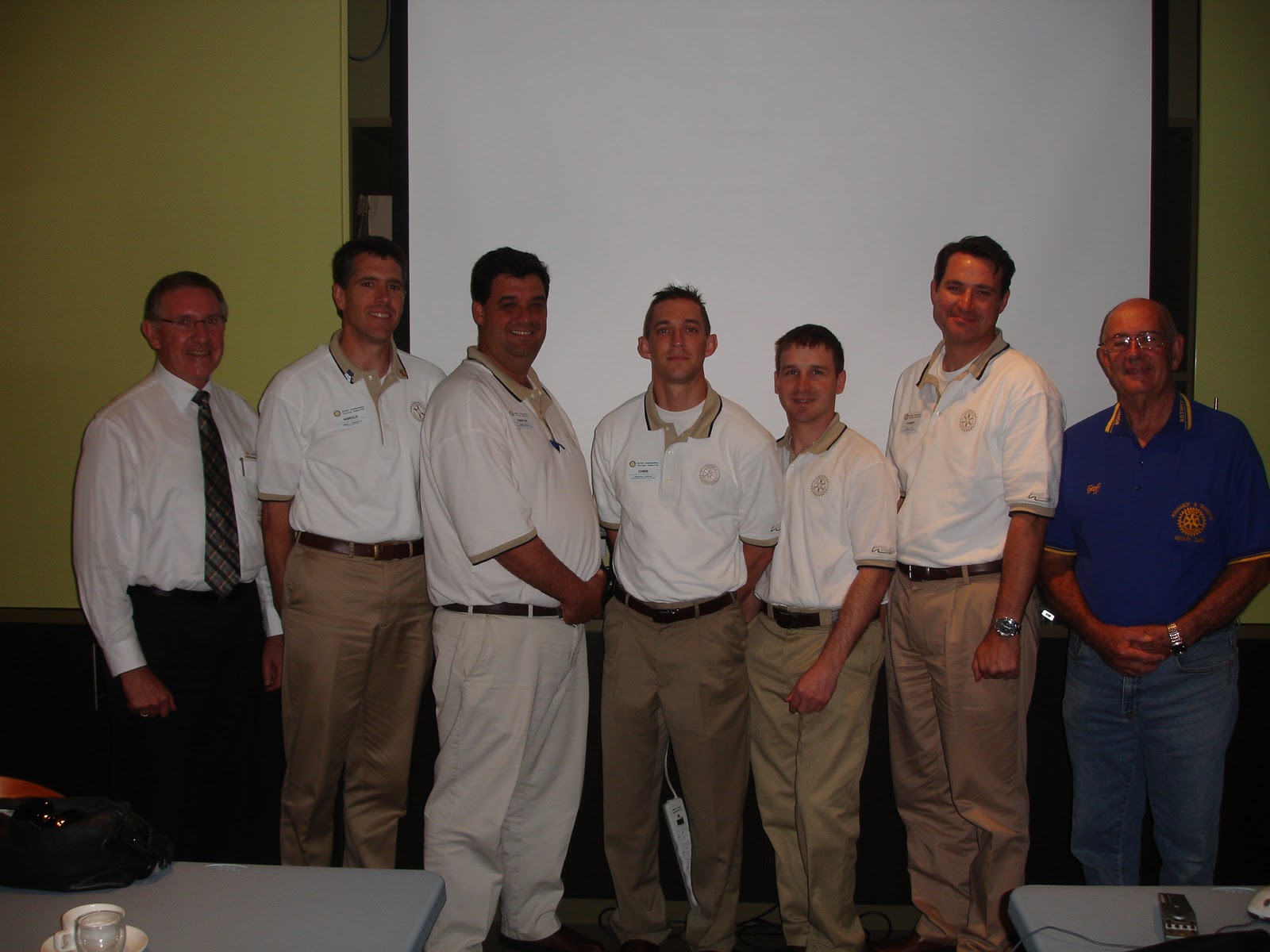
Mooloolaba Rotarians and the VTT

District 9600 Conference


March 26
We did not attend the Saturday morning session as we needed to work on our presentation.  We presented earlier in the week in Maleny and spoke for nearly 45 minutes.  They said we could go 30 minutes or so because it was an evening social with their spouses.  None of us realized we spoke for such a long time.  Our aim Saturday morning was to trim the presentation to 20 minutes.  Both the Australian team and our team were allotted only this much time and we did not want to be cut off during our presentation.  After we worked on the presentation and trimmed off a few slides, we attended the luncheon and stayed for a short time during the 2nd plenary session.  Our host families from Mooloolaba then took us home where we relaxed a bit before getting ready for the Mardi Gras governor's banquet that evening.  We wore our maroon polos - Queensland's official colors and brought plenty of beads and stuffed animals to hand out to the convention goers.  Several were dressed for the occasion and they even had a costume contest.  Following a great meal of either fish or fillet mignon (they alternate plates for their functions), the band played and we did a bit of dancing including a second line Mardi Gras dance.  Jonathan misplaced his famed monkey "GG" and was quite upset.  We thought a convention goer thought it was a gift and walked off with it.  Turns out Robert and he switched places at a table during the evening and Jonathan left it there.  Robert had picked it up and put it in his backpack.

March 27
We arrived at conference at 8am as the VTT presentations began at 9am.  The Australian team went first and spoke for 25 minutes but were not cut short.  We followed and also spoke for 25 minutes.  Went well.  Presented banners from the District, the Lafayette-North and Thibodaux clubs to the Governor. Oh, and because the conference goers knew how much GG meant to Jonathan, they insisted GG be on stage for our presentation.  Following the presentation, we were interviewed by a college student who was needing to complete an assignment for one of her courses.  Conference closed at noon and our host families took us back to Mooloolaba.
-Harold

Australia Zoo


Thursday March 24 2011

The team had an excellent afternoon at the Australian Zoo where we encountered many of Australian's indigenous and unique plants and animals, as well as many of the exotic species found on other nearby continents. We were very familiar with the zoo's founder, the late Steve Irwin, commonly known as the "Crocodile Hunter" from the very popular series of the Animal Planet..."CRIKEY!!!!".  http://www.australiazoo.com.au/

The most treasured part of the experience was a very exclusive and behind-the-scenes tour of the adjoining Animal Hospital. We were also able to visit for a few minutes with Animal Rescuer Kate, who is a member of the Australian VTT Exchange Group that recently visited Louisiana within Rotary District 6200. The hospital works to rescue, rehabilitate, and protect injured wildlife from the region such as koala bears, snakes, birds, turtles, wallabies, and kangaroos. The level of care received by the animals is truly top notch!

http://wildlifewarriors.org.au/wildlife_hospital/

-Robert